11.30.2005

Remember To Blink


Squinting at a computer screen can cut in half the number of times someone blinks each minute. And that could lead to an irritating condition called dry eye, new research suggests.

The more that the participants in this study squinted their eyes, the less they blinked. And the less they blinked, the more their eyes ached or burned, and the more they reported sensations of dryness, irritation and tearing.

Just a slight amount of squinting reduced blink rates by half, from 15 blinks a minute to 7.5 blinks a minute.

“People tend to squint when they read a book or a computer display, and that squinting makes the blink rate go way down,” said James Sheedy, the study's lead author and a professor of optometry at Ohio State University. “Blinking rewets the eyes. So if your job requires a lot of reading or other visually intense work, you may be blinking far less than normal, which may cause eye strain and dry eye.”


One more occupational hazard for all of us to worry about.

From TechNudge.

11.29.2005

Read before you crank up the volume.


...CBS News medical contributor Dr. Mallika Marshall reports when the volume goes up, so does the risk of hearing loss — dramatically.

Audiologist Brian Fligor of Children's Hospital Boston has found that personal stereo systems, like the iPod, can lead to significant hearing loss. He says there are two critical factors: how loud the music is and how long you listen.

"Noise induced hearing loss develops insidiously," Fligor says.

He tested to see how loud Dr. Marshall likes her music. She was safe at around 80 decibels — or about half way up the dial.

But at decibel levels over 85, Fligor suggests no more than an hour a day with headsets outside the ears — and only 15 minutes with those inside.

"For some types of inner ear phones, most certainly, there is greater potential for danger," Fligor says.

While kids might be the most vulnerable to hearing loss, the generation which included the first Walkman users is now showing some of the worst hearing loss.

As our patients listen to these their MP3 music players for hours each day, unfortunately, hearing loss will increase.

More Compressions & Add Some Cold


In a radical change from the way everyday people do CPR, new recommendations urge many more chest compressions.

The revised guidelines issued Monday by the American Heart Association on cardiopulmonary resuscitation change the ratio of chest compressions to rescue breaths from 15 compressions for every two rescue breaths to 30 compressions for every two rescue breaths.

And while the guidelines advocate a "back to basics" approach for the public, they recommend that emergency personnel get more high-tech by cooling cardiac arrest patients for 12 to 24 hours to about 90 degrees Fahrenheit.

Two significant studies have shown that such cooling resulted in improved survival and brain function for those who were comatose after initial resuscitation


Every two years most of us recertify our ACLS skills to be up to date on the latest cardiac resuscitation techniques. The AHA is changing the ratio to 30 compressions to two breaths. Also, some tolerable hypothermia post arrest (assuming they make it) is good for the brain.


Some more info here.

11.28.2005

Your Vote Is Needed


I just read about this contest today, and I would love to get our blog some recognition. I know we're quite new, but if you like what you see, then vote for us in the Medical Weblog competition over at MedGadget. Please vote for us (by writing into the comments section on the link provided in the title) in the "Best New Medical Weblog" category. Thanks for your support.

Welcome to the second annual Medical Weblog Awards! These awards are designed to honor the very best in the medical blogosphere, as decided by you--the readers of these fine medical blogs.

It's been another year filled with explosive growth, stirring debate, and excellent writing -- in a number of fields. Our categories reflect this diversity. The categories for this year's awards will be:

-- Best Medical Weblog

-- Best New Medical Weblog (established in 2005)

-- Best Literary Medical Weblog

-- Best Clinical Sciences Weblog

-- Best Health Policies/Ethics Weblog

-- Best Medical Technologies/Informatics Weblog


"I like playing in traffic." Bill O' Brien (and I like it too)!

11.27.2005

Surprised...?


Doctors will provide higher quality care when given financial incentives to do so, concludes a three-year study of seven so-called P4P (pay-for-performance) programs. However, it's still not clear "whether the return on investment and the quality gains outweigh the financial and human effort," according to the Robert Wood Johnson Foundation, which funded the study.


We needed a three year study on this? After all, isn't this why communism fell?

From eWeek.

Free Medical Books


FreeBooks4Doctors.com is to medical texts what TBR is to regular textbooks. A fantastic site, no ads, all the books are really free, and there are plenty of books in other languages. Books are viewable online in HTML or as free PDF downloads. Highly Recommended!


We all know the price of medical books. What drives me crazy is that there always is a new edition coming out, and it's hard (and expensive) to stay current. Well, here's a way to be really up to date, and you can't beat the price! Starving med students rejoice. I looked around and found a wealth of info for every specialty! Check it out.

11.25.2005

Treadmill Bike


There is nothing wrong with just walking!

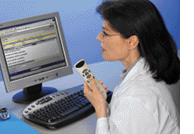
Wireless Voice Dictation


This is the wave of the future. Not only is it faster, and more convenient, but also cheaper. What else could you want?

"There's something quaint about the way Dr. Matthew Doppelt used to take electronic notes. The solo practitioner at South Eastern Dermatology Consultants P.A. in Knoxville, Tenn., used to speak into a digital recorder, upload the files, and send them to a transcription service. Then he'd cough up $1,600 a month for next-day service to get Word files of the reports.

Things changed last year when Doppelt got a wireless Toshiba M200 tablet PC running Dragon NaturallySpeaking Medical voice-recognition software from Nuance Communications Inc., an app he bought for less than $1,000. Now his dictation is electronically transcribed immediately as text. Doppelt can store those reports in patients' electronic medical records, using software from eClinicalWorks to manage those records.

Doppelt isn't alone in making this change. Medical functions that were commonly outsourced are increasingly being automated. Not only that, but in medical practices, where wireless networks are becoming important tools for clinical applications such as writing electronic prescriptions, the ability to transcribe notes using wireless devices is becoming critical. Other providers of voice-recognition dictation products include Philips and IBM."

Switching To An Electronic Medical Record


Let's face it: our profession is one of the last things out there that still uses handwriting on paper. We've all heard the benefits of an electronic patient record, but most hospitals are still state of the art 1975 when it comes to charting. This is a nice article about one clinic's success in the move from paper to digital.
While there are obvious benefits of a major computer upgrade, the real focus of the Mary Street project was converting to EMR. That was not a trivial undertaking.

“Mary Street went through a learning curve,” says Mitchell. He notes that there’s an inevitable performance hit, but that it quickly pays off. “You tend to lose twenty percent of your productivity the first month, ten percent in the second month, then break even in the third month. You then become very efficient.”

Dodds agrees that it took some effort to make the transition. “Different people within our clinic did it differently,” he notes.

“I’m one of the technophiles,” says Dodds. In particular, he types moderately well. So his own approach was to computerize everything he could. “I would go through the entire chart and try to archive it,” he recalls.

But even so, it was far from a trivial process. “How do you go from a paper chart to electronic records?” asks Dodds. Especially when that ‘chart’ may be a folder a half-inch thick... and you may have filing cabinets full of ones just like it? “It’s the single biggest issue with going electronic,” says Dodds. “You don’t just scan it all. You have to pick out what’s relevant.”

“We did a dual system for quite a while,” Dodds continues. Thus, the clinic opted to digitize old information as-needed, while keying new information directly into the new EMR system. The result was that after about four visits, most patients’ relevant information would end up in the EMR system.

Anything missing at that point can still be retrieved from the old paper folder and scanned in, as required. Fortunately, the scanning process is fairly efficient. “Scanning and OCRing [optical character recognition] are extremely fast and very accurate,” says Dodds.

At this point, the clinic is over the worst of the transition. “I get maybe one chart a week that we haven’t finished archiving,” he reports. Still, even now, when a patient is being sent to a surgeon, the full history needs to be dug out.

11.24.2005

Cranberries Beneficial To Teeth


I thought of this today while I was eating some cranberry sauce.
"Cranberries, which already are known to help thwart urinary tract infections, may also prevent tooth decay and cavities, dental researchers reported in the January issue of the journal Caries Research.

The same sticky compounds in the small, hard red fruit -- which is boiled into a jelly that is a staple at American winter holiday meals -- that help keep bacteria at bay in the bladder also appear to help prevent bacteria from clinging to teeth, according to the researchers.

They also found it seemed to help ward off plaque, a gooey substance formed from bits of food, saliva, and acid that can harbor bacteria and eventually irritate the gums.

"There's potential to find compounds there that prevent dental cavities," said Hyun Koo, an oral biologist at the University of Rochester Medical Center in New York."

11.23.2005

Rx: Internet Therapy???


Just one more use of the world wide web.


Internet-based treatments for sufferers of panic disorder may be just as effective as face-to-face methods, a study by Monash University researchers has found....

The study compared the effectiveness of three types of treatment -- internet-based cognitive behaviour therapy sessions, face-to-face sessions, and the use of medication (Selective Serotonin Reuptake Inhibitor) monitored by a psychiatrist.


Some more info:
"If the online method is as effective as face-to-face sessions, as our research suggests, this is likely to improve treatment accessibility for so many people, particularly in rural areas where people may not be able to access face-to-face treatment easily," she said.

"It could also be particularly useful to people suffering agoraphobia, who may feel unable to leave the house."

"We're not saying there will be no need for face-to-face therapy, this is just another method of therapy that people can access."

11.22.2005

CABG1 + Stents Shows Promise


DALLAS, Nov. 16 — Combining robotically assisted coronary artery bypass surgery (CABG) with stented angioplasty shows promise for treating extensive coronary artery disease, researchers reported at the American Heart Association Scientific Sessions 2005.

“The minimally invasive procedure effectively bypassed or opened blocked arteries in all 27 patients, an outcome as good or better than you would expect with open chest surgery,” said Marc R. Katz, M.D., lead author of the study and chief of cardiac surgery and director of the Virginia Transplant Center at Henrico Doctors’ Hospital in Richmond.

“The patients stayed in the hospital an average of only two and a half days, compared with five or six days for conventional CABG surgery,” Katz said. “And they were back to work in a week or so, compared with the usual six to 12 weeks.”

The study involved patients with multi-vessel coronary disease, including obstruction of the left anterior descending coronary artery (LAD), the main artery in the front of the heart.

During the closed-chest bypass procedure, the left internal mammary artery (in the chest) was harvested. Doctors then sutured the mammary artery to the obstructed LAD, bypassing the obstruction, all done endoscopically.

During the angioplasty procedure, doctors used stents (mesh tubes) to unblock other arteries and then prop them open.

11.20.2005

Bird Flu In Canada


Bird flu is definitely on the move.

Ken Falk, President of Fraser Valley Duck and Goose Ltd., lost 140,000 birds in the outbreak of a bird flu in Canada's western province of British Columbia in 2004. Now he is bracing for another possible hit to his family-owned business.

Falk's farm remains under quarantine a day after one of his 60,000 ducks tested positive for the H5 strain of bird flu.

Officials from the Canadian Food Inspection Agency (CFIA) are visiting farms in a five-km radius around the duck and goose farm in the town of Chilliwack in southern British Columbia. They are warning bird owners to practise strict biosecurity.

Swab samples from the infected ducks are on their way to a national health research center in Winnipeg, which houses one of the world's most secure labs for the testing of deadly diseases, for further testing. It will take two days of tests to determine if it is the same type that has infected humans in Asia.

On Saturday, local reports say the CFIA will order the cull of all birds on Falk's farm, meaning a precautionary killing of Falk's birds.

"We have to do something to ensure this H5 strain doesn't mutate and get into the environment," Cornelius Kiley with the CFIA told CTV.

"Obviously we're very sad about that. And it's going to be hard but as an industry, we've decided to be proactive," Falk said.

According to Saturday's Vancouver Sun, the virus showed up after Falk sent a sample of birds from his farm to a government lab to be tested for something unrelated to avian flu.

Viagra For Pulmonary HTN


I'm thinking patient compliance will be high with this one.

NEW YORK (Reuters Health) - Treatment with Viagra (sildenafil) can improve exercise capacity and functional ability in patients with pulmonary arterial hypertension, a serious disease involving high pressure in the blood vessels that enter the lungs, new research suggests.

The findings, which appear in The New England Journal of Medicine, are based on a study of 278 patients who were randomly selected to receive Viagra, at one of three doses, or inactive "placebo" three times daily for 12 weeks.

The main endpoint was the distance walked in 6 minutes. According to the report, the study did not have enough patients to assess the effect of Viagra on the risk of death.

At all of the doses tested, Viagra significantly improved the 6-minute walking distance when compared with placebo, lead author Dr. Nazzareno Galie, from the University of Bologna in Italy, and colleagues note. For the 222 patients who used Viagra for 1 year, the improvement in distance was 51 meters.

In addition, all of the Viagra doses were associated with a significant drop in lung blood pressure and with an improvement in functional ability.

11.18.2005

Printing Skin


I wonder if they will charge more for the cartridges than the printer? HP would love to sell this to my hospital.

You have a printer. What would you normally do with it? Print documents, probably forms and even a few photographs? Did you ever think you could print skin for yourself? How about organs, or even notebook screens?


If you think I’ve lost all of my senses, you are more wrong than Bill Gates was about future memory requirements.


So what exactly am I talking about? Researchers at the University of Manchester have developed an exciting technology where you take cells from the patient’s body and feed them into the computer. The system then analyses and multiplies them to the required level, which then fills up as "ink" in the first cartridge while the second cartridge contains the necessary gel. Once the process has started, multiple print layers ensure that a complex 3D skin is created and the dimensions are exactly as required